
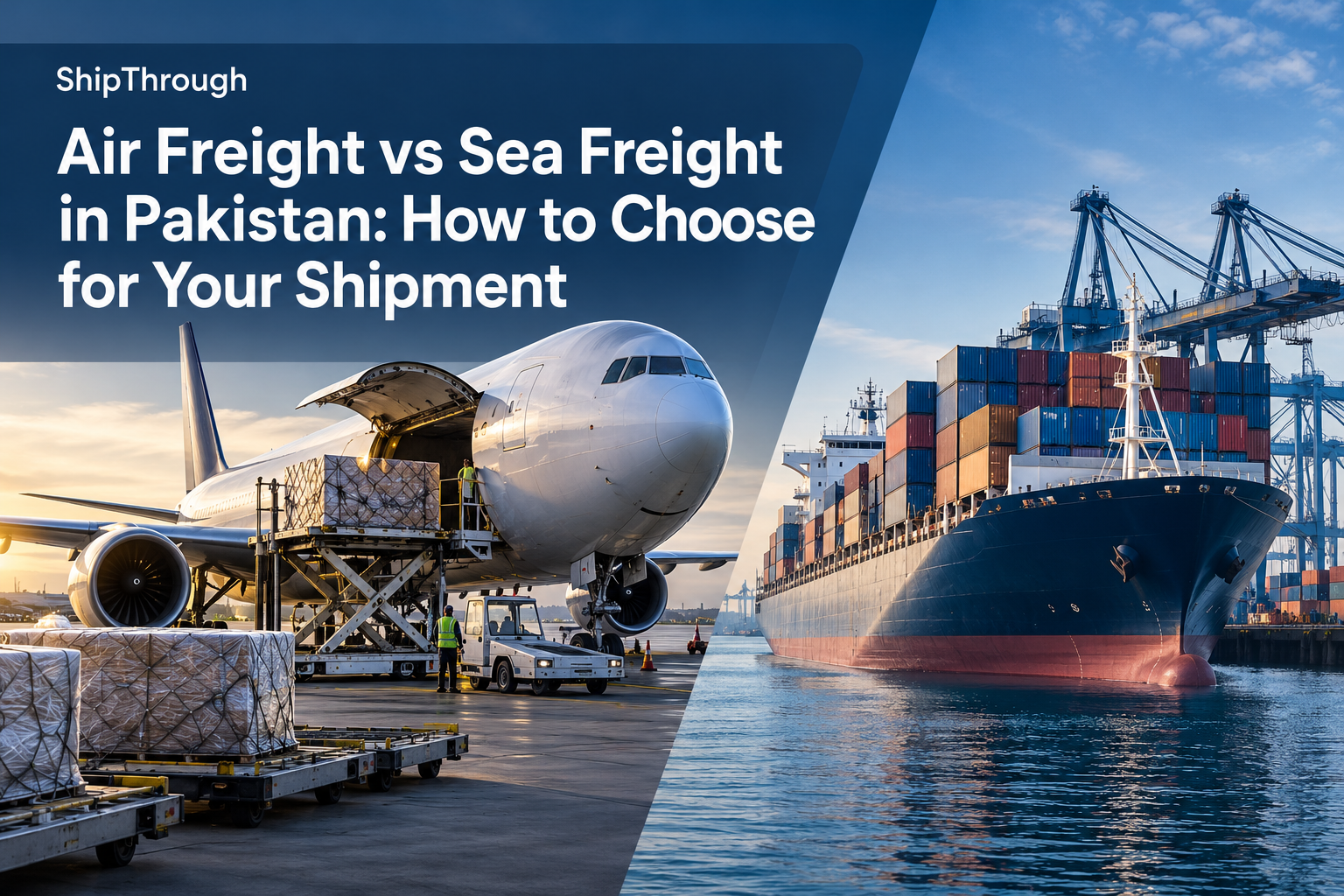

Which is better for your shipment
Air freight is usually suitable when delivery speed matters most, while sea freight is often a practical choice for larger shipments with flexible deadlines. For businesses in Pakistan, the right decision depends on the goods, shipment size, required arrival date, and total delivery cost. Compare the complete journey from supplier pickup to your receiving location before selecting a transport mode.
A low freight rate can become expensive if the shipment arrives too late for production or sales. Equally, paying for air transport may bring little benefit when stock is not needed immediately. Start with your business deadline, then work backward through preparation, clearance, and delivery.
What air freight includes
Air freight services coordinate cargo movement by aircraft alongside the other arrangements needed to complete the shipment. Depending on the agreed scope, this may involve pickup, export procedures, airport handling, the air journey, import clearance, and onward delivery.
Businesses often consider this option for samples, urgent replenishment, replacement components, or commercial goods with short sales windows. However, a fast flight does not remove every other stage. Cargo readiness, available capacity, handling requirements, and customs procedures can affect the actual delivery date.
Ask whether the estimate covers airport arrival or delivery to your premises. These are different milestones, and confusing them can leave your receiving team unprepared.
What sea freight includes
Ocean freight services move commercial cargo by sea, with arrangements for ports, documentation, and inland transport where required. Businesses can use a dedicated container through FCL shipping or share container capacity through LCL shipping.
Sea freight is often useful for regular replenishment, larger purchase orders, and cargo that does not need immediate delivery. It can provide substantial capacity, although the complete schedule must allow for vessel departure, possible transshipment, destination handling, clearance, and inland movement.
For shared-container shipments, consolidation before departure and separation after arrival add further steps. Ask how these are reflected in the delivery estimate.
Compare the complete delivery timeline
The important question is not simply how long the aircraft or vessel travels. It is when the goods will become available for your business to use.
Write down the date your supplier can release fully packed cargo. Then identify your latest acceptable delivery date. The time between these points must accommodate collection, origin handling, international transport, destination procedures, and final delivery.
For example, a manufacturer waiting for a replacement component may need to assess production downtime. A retailer importing products for a future season may have enough time to use sea freight. These businesses could ship from the same origin yet make different decisions because the consequences of delay differ.
Keep a reasonable buffer rather than planning around the shortest possible estimate.
Compare total cost rather than one rate
Request quotations with matching pickup points, delivery points, cargo measurements, and service scope. Otherwise, an airport-only quotation might appear cheaper than a complete door delivery offer even though they cover different work.
For air cargo, the amount billed can depend on chargeable weight, which accounts for physical weight and occupied space. For sea cargo, the pricing basis differs between dedicated containers and shared shipments. Handling, documentation, clearance coordination, and inland transport can also influence the total.
Consider the business cost of waiting. Running out of stock, missing a sales window, or stopping production may outweigh freight savings. Conversely, unnecessary urgency can consume margin without improving customer service.
Assess cargo suitability and packaging
Before comparing prices, disclose the commodity, final packed dimensions, gross weight, and special handling needs. Batteries, liquids, chemicals, fragile items, and oversized pieces may require additional assessment. Suitability depends on the goods and the applicable transport requirements.
Packaging should protect the product throughout the chosen route. Cargo may pass through multiple handling points, and sea shipments may spend longer in transit. Ask your supplier for transport-appropriate packing rather than assuming the retail carton is sufficient.
Do not change declared dimensions or remove protection just to obtain a lower quote. Accurate details make the booking and cost estimate more dependable.
Can you combine air and sea freight
Sometimes splitting a purchase order is worth evaluating. A business might send a small urgent quantity by air and the remaining stock by sea. This can bridge an immediate shortage while preserving a more economical replenishment plan.
The split introduces separate paperwork, handling, and shipment coordination, so compare the combined cost carefully. Confirm that the supplier can separate the order correctly and that both shipments have clear package identification.
You can also coordinate customs clearance services and road freight transportation around each arrival. The international transport mode is only one part of the delivery plan.
Questions to answer before booking
- When will the goods be fully packed and available?
- What is the latest acceptable delivery date?
- What are the packed dimensions and gross weight?
- Are there special handling or acceptance requirements?
- Does the quotation include clearance and final delivery?
- What happens commercially if the shipment arrives later than expected?
Use these answers to compare realistic options rather than choosing on speed or price alone.
Frequently asked questions
Is sea freight always cheaper than air freight
No. It is often economical for larger cargo, but shipment size, minimum charges, handling, route, and delivery scope affect the comparison. Obtain complete quotations for your actual shipment.
Is air freight guaranteed to arrive by a specific date
Do not assume a delivery estimate is a guarantee. Confirm the booked service, milestone covered, exclusions, and any contractual commitment before relying on a fixed date.
Which option suits a small business
Either can be suitable. Small businesses should compare urgency, cargo volume, cash flow, and total cost rather than selecting a mode solely because of company size.
Plan the shipment around your business deadline
Share your cargo details, origin, destination, and required delivery date when you request a freight quote. ShipThrough can review the shipment requirements and help coordinate an appropriate transport solution.