
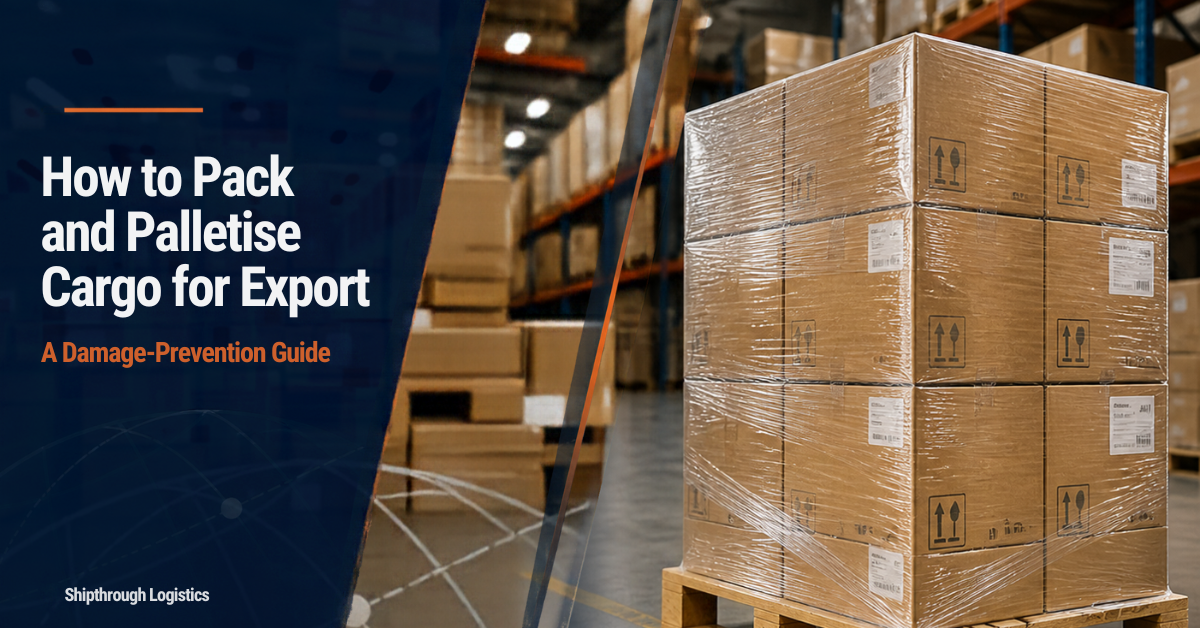

Short answer: To pack cargo for export shipping, use packaging that suits the product’s weight and fragility, consolidate cartons onto sturdy pallets, secure them with strapping and stretch wrap, use ISPM 15-treated wood for any timber packaging, and mark every package clearly. Then record the final packed dimensions and weight, because those numbers drive your freight quotation and your documents.
Export cargo is loaded, moved, lifted and unloaded many times before it reaches the buyer. Good packing lowers the chance of damage, disputes and delays at each stage.
Step 1: Choose the right outer packaging
Start with the product, not the box you already have.
- Corrugated cartons suit light and medium goods such as garments, packaged food and small consumer items. Double-wall cartons give better stacking strength than single-wall.
- Wooden crates or cases suit machinery, heavy parts and fragile equipment that cannot rely on cardboard alone.
- Drums, bags and IBCs are used for liquids, powders and granules, each with its own sealing and handling needs.
Fill empty space inside the package with dunnage such as foam, air pillows or cardboard dividers. Goods that can move inside a carton are far more likely to break than goods held firmly in place.
Step 2: Palletise for safer handling
Pallets let forklifts move cargo as one unit instead of as dozens of loose cartons. This reduces manual handling, which is where many breakages happen.
When building a pallet:
- Keep the load within the pallet’s edges. Overhanging cartons get crushed against container walls or neighbouring pallets.
- Place heavier cartons at the bottom and lighter ones on top.
- Stack cartons in an interlocking or column pattern, depending on carton strength. Column stacking carries more weight; interlocking gives more stability.
- Use corner boards (edge protectors) to stop straps from cutting into cartons.
- Secure the load with strapping and several layers of stretch wrap, including a wrap around the pallet base.
If your goods will travel in a shared container, firm palletising matters even more, since other shippers’ cargo sits beside yours. Our guide to full and shared container shipments explains how loading differs between the two.
Step 3: Follow ISPM 15 for wood packaging
Many countries require wooden pallets, crates and dunnage used in international trade to meet ISPM 15. This international standard requires wood packaging to be heat-treated or fumigated and stamped with an approved mark. It exists to stop pests from travelling in untreated timber.
Practical points:
- Ask your pallet or crate supplier for ISPM 15-marked wood and check the stamp is visible.
- Plastic, metal and engineered-wood pallets (such as plywood or particle board) are generally outside the standard, but confirm the rules for your destination.
- Non-compliant wood packaging can lead to inspection, treatment, re-packing or the shipment being refused at destination.
Step 4: Pack differently for air and sea freight
The same product often needs a different approach depending on the mode.
For air shipments, space costs money. Airlines charge on the higher of actual weight and volumetric weight, so oversized cartons with lots of empty space increase the bill. Our article on actual and volumetric weight shows how to calculate this. Keep packaging protective but compact, and check pallet heights against what the airline and aircraft can accept. Our air cargo team can confirm size limits before you pack.
For sea shipments, cargo faces longer transit, humidity and the movement of the vessel. Consider:
- Moisture protection such as plastic liners, desiccant bags inside the container, or vacuum packing for sensitive goods.
- Stronger cartons, since sea freight cargo is often stacked higher.
- Bracing and lashing inside the container so pallets cannot shift.
You can discuss container loading and protection with our ocean shipping team before the goods are packed.
Step 5: Mark and label every package
Clear markings help handlers, customs officers and the consignee identify your cargo quickly. Each package should show:
- Consignee name and destination
- Package number (for example, 3 of 12)
- Gross weight and dimensions
- Handling marks where relevant: this way up, fragile, keep dry, do not stack
- Any marks your buyer, letter of credit or destination rules require
Make sure the markings match your commercial invoice and packing list exactly. Differences between labels and paperwork are a common source of questions at customs. Our export and import paperwork checklist lists what should line up.
Step 6: Record final packed dimensions and weight
Measure and weigh after packing is finished, not before. Pallets, crates and wrapping all add weight and size. Record:
- Length, width and height of each package or pallet
- Gross weight of each package
- Total number of packages and total volume
These figures go on your packing list and into your freight booking. If they change after the quotation, the charges and the space booked may change too.
Pre-dispatch packing checklist
Before the cargo leaves your premises, confirm that:
- Packaging suits the product’s weight, value and fragility
- Empty space inside each package is filled
- Pallets are stable, wrapped and within their edges
- Wood packaging carries a visible ISPM 15 mark
- Moisture protection is in place for sea shipments
- Every package is marked and numbered
- Packing list, invoice and labels match
- Final dimensions and weights are recorded
Key takeaways
- Good export packing reduces damage, claims and delays at every handling stage.
- Palletise wherever possible and keep loads within the pallet’s edges.
- Wooden packaging usually needs ISPM 15 treatment and marking.
- Air freight rewards compact packing; sea freight demands moisture and movement protection.
- Final packed dimensions and weight must match your documents and booking.
Frequently asked questions
Do I need pallets for every export shipment?
Not always. Small parcels and some air shipments move as loose cartons. Palletising is recommended when you have many cartons, heavy items or cargo that will be handled by forklift, because it reduces manual handling.
Can poor packing affect an insurance claim?
It can. Insurers often exclude damage caused by insufficient or unsuitable packing. Packing goods properly and keeping photos of the packed cargo helps if you ever need to make a claim.
Should I pack before or after getting a freight quote?
You can request an estimate earlier using expected sizes, but the final charge depends on packed dimensions and weight. Share updated figures as soon as packing is complete.
Plan your next export shipment
If you are preparing goods for export and want a second opinion on packing, pallet sizes or loading, send us your shipment details and our team will help you plan the move from your premises to the destination.