
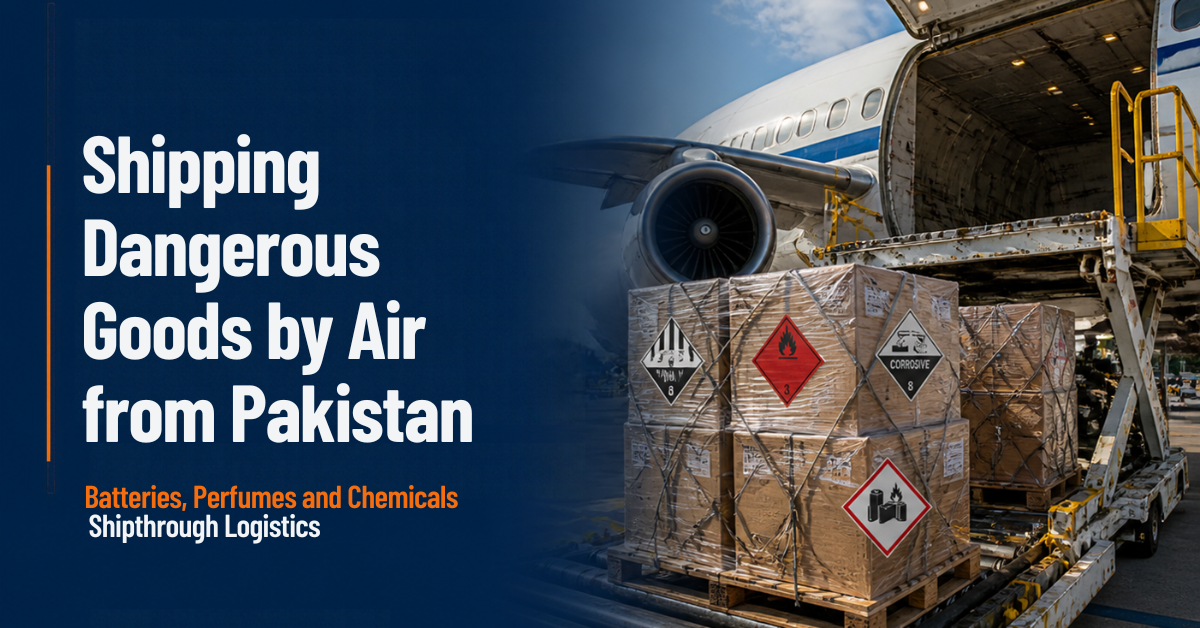

Quick answer: Dangerous goods air freight from Pakistan is possible for many products, but only when the cargo is correctly classified, packed in approved packaging, labelled and declared under the IATA Dangerous Goods Regulations (DGR). The declaration must be prepared by trained staff, and the airline can still refuse a shipment it considers unsafe or non-compliant.
Perfume cartons, power banks and paint samples are all dangerous goods. Many shippers only find out when the airline rejects the booking.
What counts as dangerous goods in air freight?
Dangerous goods (DG) are articles or substances that can endanger health, safety, property or the aircraft during flight. Pressure changes and vibration make some products riskier in the air.
The IATA DGR sorts them into 9 hazard classes:
| Class | Hazard | Common export examples |
|---|---|---|
| 1 | Explosives | Fireworks, some ammunition |
| 2 | Gases | Aerosol sprays, gas cylinders, lighters |
| 3 | Flammable liquids | Perfumes, paints, solvents, some adhesives |
| 4 | Flammable solids and substances dangerous when wet | Matches, some metal powders |
| 5 | Oxidizers and organic peroxides | Some bleaches, pool chemicals |
| 6 | Toxic and infectious substances | Pesticides, medical samples |
| 7 | Radioactive material | Certain medical and industrial sources |
| 8 | Corrosives | Acids, wet-cell batteries, some cleaning agents |
| 9 | Miscellaneous | Lithium batteries, dry ice, magnetized material |
Some items are forbidden on any aircraft, others travel only on cargo aircraft, and many are allowed in limited quantities per package.
Which common products are restricted?
Three groups cause most of the surprises for Pakistani exporters.
Perfumes and cosmetics. Alcohol-based fragrances are usually Class 3 flammable liquids. Nail polish, hair sprays (Class 2 if in aerosol form) and some creams can also fall under DG rules.
Lithium batteries. Shipped alone, packed with equipment or installed inside a device, they’re Class 9 and carry their own packing instructions. The limits depend on battery type, size and how they’re packed, so check the current IATA rules with your forwarder before you book. Damaged or recalled batteries are a different matter altogether and are normally not accepted by air.
Chemicals and industrial liquids. Dyes, resins, cleaning agents and lab reagents often have a hazard classification you won’t spot from the product name. The safety data sheet tells you.
What documents do you need to ship dangerous goods by air?
You need four things before an airline will even look at a DG booking:
- Safety Data Sheet (SDS) from the manufacturer. Section 14 gives the transport classification, including the UN number.
- Shipper’s Declaration for Dangerous Goods, signed by a person trained under the DGR. It lists the UN number, proper shipping name, class, packing group and quantity.
- Air waybill with the correct DG handling information.
- Standard commercial paperwork: invoice and packing list, as covered in our export paperwork checklist.
The signer carries legal responsibility for the declaration. If your team isn’t DG-trained, it has to be prepared through someone who is, and you still need to supply an accurate SDS.
How do you pack and label hazardous cargo?
DG packaging isn’t just a sturdy box. Most classes require UN-specification packaging that has passed drop and stacking tests, marked with a UN code. Inner containers, absorbent material and closures all matter for liquids.
Each package then needs:
- The UN number and proper shipping name
- The hazard class label (the diamond-shaped label for that class)
- Handling labels where required, such as “Cargo Aircraft Only” or the lithium battery mark
- Shipper and consignee details
Packing group (I, II or III) tells you the danger level within a class. Group I is the highest. It also changes what packaging you’re allowed to use.
Get the packing wrong and the shipment stops at airline acceptance checks.
Why airlines refuse dangerous goods shipments
Even a fully documented shipment can be turned away. The usual reasons:
- The SDS is outdated or doesn’t match the product label
- The quantity per package exceeds what’s allowed on that aircraft type
- Labels are missing, damaged or covered by straps
- The airline or route doesn’t accept that class at all (some carriers have their own stricter variations)
- The declaration has errors, even small ones like a misspelled shipping name
Refusals cost time: the cargo returns, the booking is lost and the buyer waits. That’s why it pays to share the SDS when you first ask for a rate, not after the cargo is packed. Our guide to the details to include in a quote request covers what else to send upfront.
When is sea freight the better option for dangerous goods?
Air isn’t always the answer for hazardous cargo. Sea transport follows its own code (the IMDG Code) and often accepts larger quantities and some items that are restricted in the air.
Consider moving by sea when:
- The product is only accepted on cargo aircraft and capacity is tight
- Quantities exceed air limits per package
- The delivery date allows a longer transit
If you’re weighing both, our article on comparing air and sea routes walks through timing and total cost. For larger volumes, our sea freight service for restricted cargo can be planned with the same DG documentation in hand.
Key takeaways
- Many ordinary products, including perfumes, aerosols and lithium batteries, are dangerous goods by air.
- The IATA DGR groups them into 9 classes, each with its own packing and labelling rules.
- A trained person must sign the Shipper’s Declaration; the SDS is the starting point.
- Airlines can refuse non-compliant or unsuitable DG cargo, so confirm acceptance before packing.
- Sea freight is often a practical alternative for larger or restricted quantities.
Frequently asked questions
Can I ship perfume by air from Pakistan?
Usually yes, as Class 3 flammable liquid, provided it’s packed in approved packaging, labelled and declared correctly. Quantity limits apply per package, and some airlines restrict it further.
Can lithium batteries be sent by air cargo?
Many types can, under specific IATA packing instructions that depend on battery type and how they’re packed. Damaged or defective batteries are generally not accepted. Check the current rules with your forwarder for your exact product.
Do I need an MSDS to ship chemicals?
Yes. A current Safety Data Sheet (the newer name for the MSDS) is needed to classify the product and prepare the DG declaration. Without it, the airline can’t assess the cargo.
Plan your dangerous goods shipment
Send us your SDS, packed quantities and destination, and our team will check what’s needed for your air cargo shipments from Pakistan before you book. Request a quote to get started.