
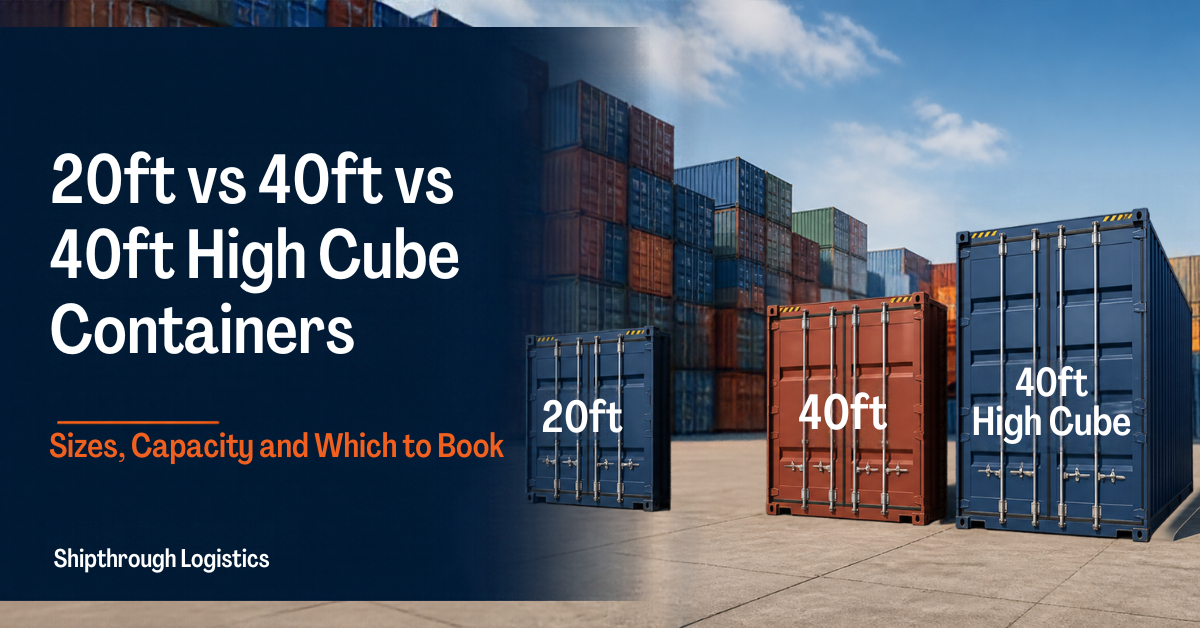

Short answer: A 20ft container holds about 33 cubic metres and suits heavy, dense cargo such as machinery parts, tiles or rice. A 40ft container holds about twice the volume, around 67 cubic metres, and usually costs less per unit for medium-weight goods. A 40ft high cube adds roughly 30 cm of height, about 76 cubic metres in total, which helps with light, bulky products such as furniture, garments or packaging. The right choice depends on whether your cargo will hit the weight limit or the space limit first.
Once you know you need a full container rather than shared space, the next decision is size. If you are still deciding between those two options, our guide on full container and shared container shipping covers that step first.
Container dimensions compared
The figures below are typical internal measurements for standard dry containers. Exact numbers vary slightly by shipping line and container manufacturer, so confirm the specification for your booking.
| Container | Internal length | Internal width | Internal height | Approx. volume | Approx. max payload |
|---|---|---|---|---|---|
| 20ft standard | 5.90 m | 2.35 m | 2.39 m | 33 m³ | about 28,000 kg |
| 40ft standard | 12.03 m | 2.35 m | 2.39 m | 67 m³ | about 26,500 kg |
| 40ft high cube | 12.03 m | 2.35 m | 2.69 m | 76 m³ | about 26,500 kg |
Two details matter more than people expect. First, the door opening is smaller than the internal width and height, so tall or wide items must be measured against the door, not the box. Second, a 40ft container does not carry twice the weight of a 20ft. It carries twice the space, but its maximum payload is similar or slightly lower.
Weight limit or volume limit: which comes first?
Every shipment runs out of either weight allowance or floor and air space before the other. Working out which one applies to your cargo is the fastest way to pick a container.
- Dense cargo reaches the weight limit first. Steel parts, stone, ceramic tiles, bagged grain and liquids in drums can max out a 20ft container while leaving empty space at the top. Booking a 40ft for these goods often adds cost without adding usable capacity.
- Light cargo reaches the volume limit first. Textiles, foam, plastic household goods, furniture and empty packaging fill a container long before they approach its weight limit. Here the extra volume of a 40ft or 40ft high cube is worth paying for.
To check, divide your total gross weight by your total packed volume. If the result is high (several hundred kilograms per cubic metre or more), plan around weight. If it is low, plan around space.
Inland delivery can also limit how much weight you load. Road vehicle rules and the trailer used for the final leg may cap the practical weight of a loaded container, so discuss heavy loads with your transport provider before you pack. Our cargo transportation service team can confirm what the onward truck can carry.
How many pallets fit in each container?
Pallet counts depend on pallet size, orientation and whether you stack. As a rough single-layer guide:
- 20ft container: about 10 standard pallets (1.2 m × 1.0 m) or 11 Euro pallets (1.2 m × 0.8 m)
- 40ft container or 40ft high cube: about 20 to 21 standard pallets or 23 to 24 Euro pallets
The high cube does not fit more pallets on the floor, because the floor is the same size as a standard 40ft. Its advantage appears when pallets can be double-stacked or when loose cartons can use the extra height.
When a 40ft costs less per unit
A 40ft container is rarely double the price of a 20ft on the same route. That means the cost per cubic metre often falls when you move to the larger size, as long as you can fill it.
This makes a 40ft worth considering when:
- your cargo is light and you are close to filling a 20ft already
- you can combine two smaller orders into one shipment
- you want fewer containers to clear, transport and unload
It makes less sense when the cargo is heavy, when your warehouse cannot receive a 40ft trailer, or when you would ship the container half empty. Always compare the complete landed cost, including local charges, inland haulage and unloading, rather than the ocean rate alone. A clear freight quote request with packed dimensions and weights makes this comparison much easier.
Special containers for cargo that does not fit
Some goods do not suit a standard dry box at all:
- Open top: for tall machinery or items loaded by crane from above
- Flat rack: for oversized equipment, vehicles or steel structures wider than the door
- Reefer: for food, pharmaceuticals and other temperature-controlled cargo
These are less widely available and usually cost more, so request them early.
How to choose your container size
Use this short checklist before you book:
- Measure every package after packing, including pallets.
- Add up total gross weight and total volume.
- Decide whether weight or volume will limit you first.
- Check that the largest item fits through the container door.
- Confirm the receiving site can take the container and trailer size.
- Compare the total cost per unit for each realistic option.
Our ocean freight and container shipping team can review your packing list and suggest the container that fits your cargo and budget.
Key takeaways
- A 20ft is best for heavy, dense cargo; a 40ft or 40ft high cube is best for light, bulky cargo.
- A 40ft offers about twice the volume of a 20ft but not twice the payload.
- The high cube adds height, not floor space.
- Compare the full landed cost per unit, not just the freight rate.
Frequently asked questions
What is the main difference between a 20ft and 40ft container?
The 40ft container is twice as long and offers about twice the volume, roughly 67 cubic metres against 33. Its maximum payload is similar to a 20ft, so it suits lighter cargo that needs more space.
Is a 40ft high cube more expensive than a standard 40ft?
On many routes the price difference is small or nil, but this varies by shipping line and season. Ask for both options in your quotation.
What if my cargo is too small for a 20ft container?
Shared container shipping is usually the better option for small volumes, because you pay only for the space you use.
Get the right container for your next shipment
Send your packed dimensions, weight and route through our Request a Quote form, and the ShipThrough team in Karachi and Lahore will recommend the container size that keeps your cost per unit down.