
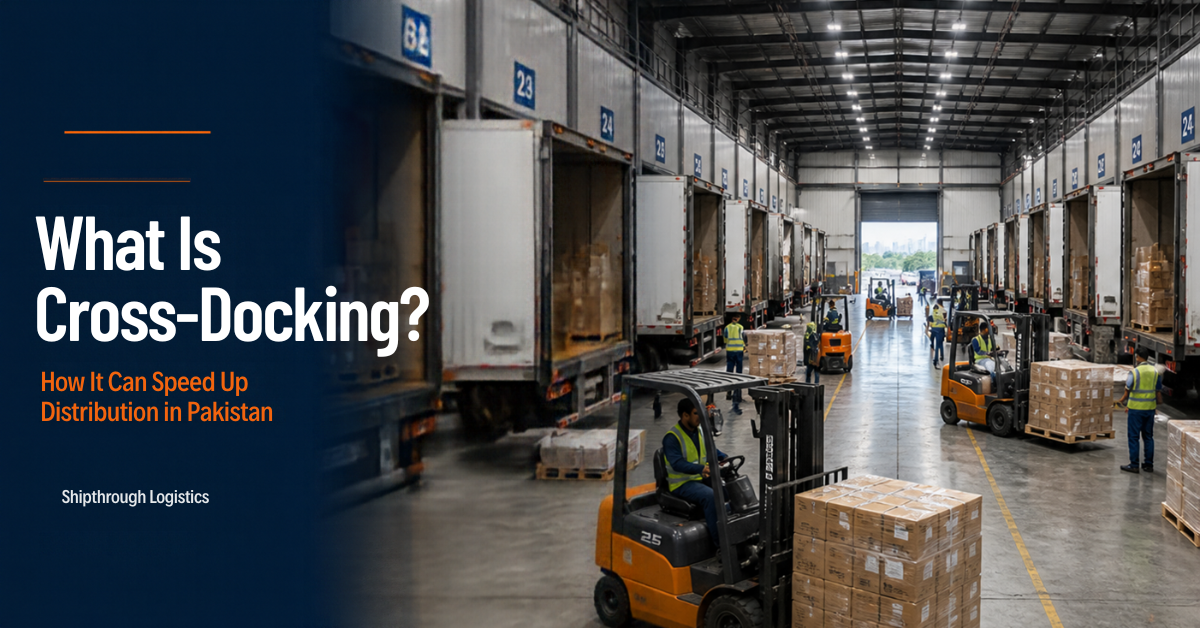

Short answer: Cross-docking is a distribution method where goods arriving on inbound vehicles are unloaded, sorted and loaded straight onto outbound vehicles, usually within hours, instead of being put away into storage. For Pakistani distributors moving fast-selling stock from a port or factory to several cities or retail points, it can cut handling time and storage cost, but only when arrivals, sorting and onward transport are planned tightly.
How cross-docking works
A cross-dock is a transfer point rather than a storage building. The flow is simple to describe and demanding to run:
- Inbound arrival. A truck or container arrives with cargo that is already destined for specific customers, branches or routes.
- Unloading and checking. Goods are counted against the shipment paperwork and checked for visible damage.
- Sorting. Cartons or pallets are separated by destination, route or customer order.
- Consolidation. Goods heading to the same place are grouped, sometimes combined with items from other inbound loads.
- Outbound loading. The sorted goods go onto the vehicles that will deliver them, ideally the same day.
The key difference from regular storage is that the goods are not put away on racks and picked later. They move from one dock to another with only brief staging in between.
Cross-docking vs regular warehousing
Both have a place in a supply chain, and many businesses use both.
| Factor | Cross-docking | Regular storage |
|---|---|---|
| Time goods stay on site | Hours, sometimes up to a day or two | Days, weeks or months |
| Main purpose | Transfer and sort | Hold stock until it is needed |
| Best for | Pre-sold or fast-moving goods | Buffer stock, seasonal stock, slow movers |
| Planning needed | High: arrivals and departures must match | Moderate: dispatch can be scheduled later |
| Risk if timing slips | Goods wait without a planned space | Low, goods are already stored |
If you are deciding how long goods should be stored at all, our guide to short term vs long term storage options covers that side of the decision.
Which products suit cross-docking
Cross-docking works best when demand is known before the goods arrive. Good candidates include:
- Fast-moving consumer goods such as packaged food, beverages and household items going to retailers or distributors.
- Pre-sold or pre-allocated stock, where each carton already has a destination.
- Imported goods for several cities, for example a container cleared in Karachi that must be split between Karachi, Lahore and Islamabad customers.
- Promotional or seasonal stock that must reach shelves on a fixed date.
- Perishable or time-sensitive goods, where every hour in storage reduces shelf life.
It is usually a poor fit for goods with uncertain demand, products that need inspection or repacking before sale, and items that must be held until a customer confirms an order.
Benefits for Pakistani distributors
Less time between arrival and delivery. Goods do not wait in storage for a picking cycle, so they reach branches, dealers or shops sooner.
Lower storage requirement. Because goods pass through instead of staying, you need less racked space for that flow of stock.
Fewer handling steps. Each put-away and pick is a chance for damage or miscounting. Cross-docking removes those steps for goods that do not need them.
Better use of transport. Consolidating loads from several inbound shipments onto fewer outbound vehicles can improve vehicle utilisation, especially on intercity routes.
Faster stock turnover. Distributors can operate with less buffer stock on hand when replenishment flows reliably.
The limits you should plan for
Cross-docking is not automatically cheaper or faster. It depends on timing.
- Arrivals must be predictable. If an imported container is held at the port, every outbound truck planned around it is affected. Many of the reasons are covered in our article on why cargo gets delayed at customs.
- Information must arrive before the goods. The cross-dock team needs to know destinations, quantities and labels in advance. Sorting without this data turns a transfer point into an unplanned store.
- Labelling must be clear. Each carton or pallet needs a destination mark that can be read quickly at the dock.
- Outbound transport must be ready. Vehicles need to be booked for the right time and size. Our comparison of dedicated trucks and shared road freight explains how to choose.
- A fallback is needed. When a delivery point cannot receive goods on time, you need short-term storage available rather than leaving cargo on the dock floor.
What a cross-docking setup needs
Before moving a product line to cross-docking, check that you have:
- Confirmed orders or allocation for each inbound shipment
- Advance shipment details: item list, quantities, carton counts and destinations
- Destination labels applied at origin, or a plan for labelling on arrival
- Dock space for unloading, sorting and staging
- Outbound vehicles matched to route and volume
- Proof of delivery and discrepancy reporting for each outbound load
- Access to connected warehousing and storage for goods that cannot move on the same day
How cross-docking fits with imports
For many importers, the most practical use of cross-docking is right after customs release. A container arrives, is cleared, and is then split at a transfer point into city-wise or customer-wise loads instead of being stored first. This works when clearance is coordinated in advance, the onward cargo transportation and delivery plan is booked, and the receiving locations are ready. Our guide on moving cargo from port to warehouse explains the stages after vessel arrival that this depends on.
Key takeaways
- Cross-docking transfers goods from inbound to outbound vehicles with little or no storage.
- It suits pre-sold, fast-moving and time-sensitive goods with known destinations.
- Its value depends on reliable arrivals, advance shipment data and ready outbound transport.
- Keep short-term storage available as a fallback when timing slips.
Frequently asked questions
Is cross-docking the same as warehousing?
No. Warehousing holds stock until it is needed. Cross-docking moves goods through a facility quickly, usually within the same day, with only brief staging.
Can a small business use cross-docking?
Yes, if it ships regular volumes to known customers. A business splitting one inbound load between several dealers can benefit, even without its own facility.
Does cross-docking reduce transport cost?
It can, by consolidating goods from several inbound loads into fuller outbound vehicles. Savings depend on volume, routes and how well timing is coordinated.
What happens if outbound trucks are not ready?
Goods have to wait on the dock or move into temporary storage. Planning a storage fallback avoids damage and congestion.
Plan your distribution flow with ShipThrough
ShipThrough coordinates clearance, transfer, storage and onward delivery from our Karachi and Lahore offices. Share your inbound schedule, volumes and delivery points through our request a logistics quote form, and our team will suggest whether cross-docking, storage or a mix of both suits your stock.